Tags: #American#SpyThrillerNovelists
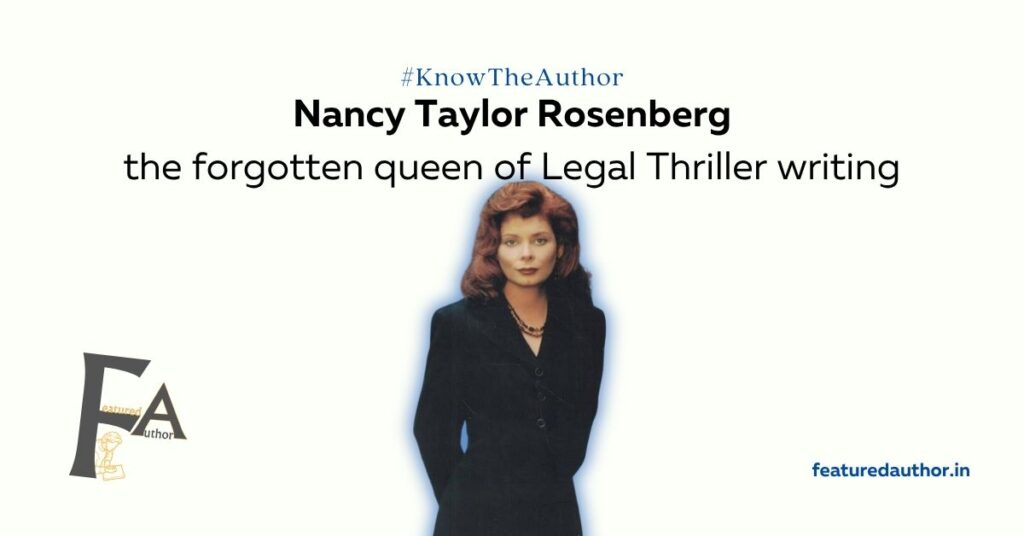
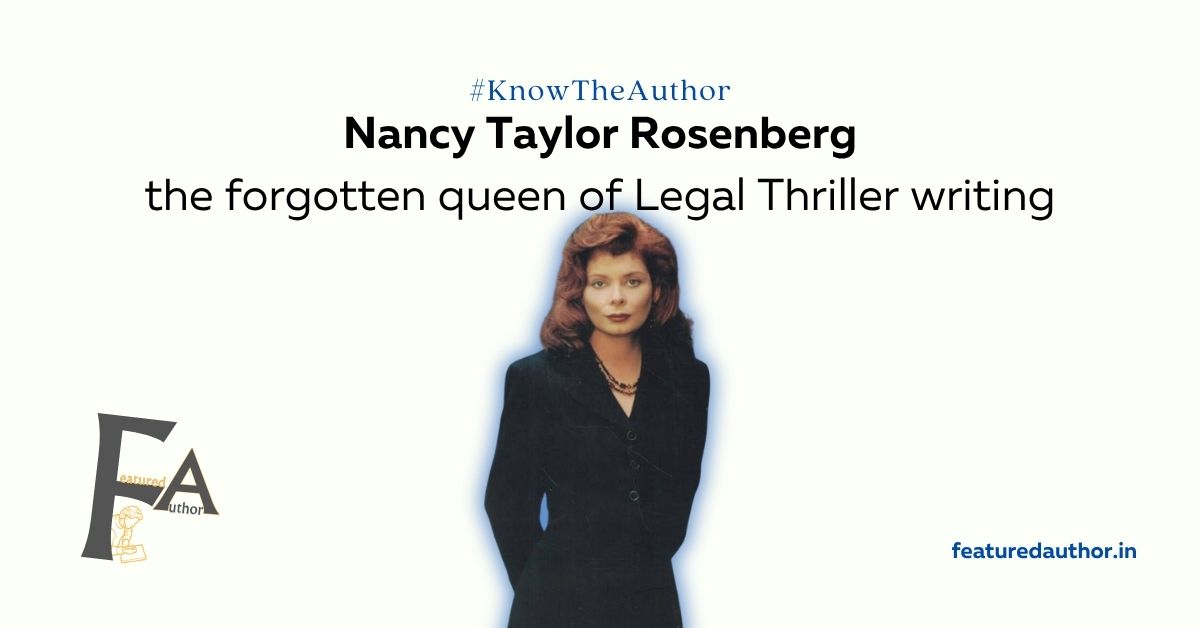
Nancy Taylor Rosenberg: The Forgotten Queen of the Legal Thriller
A Detailed Profile, Critical Appreciation, and Reading Guide
Among the many bestselling authors who dominated the legal thriller boom of the 1990s, Nancy Taylor Rosenberg occupies a rather unusual position. Readers who regularly picked up courtroom thrillers during that period will instantly recognise her name. Yet, unlike contemporaries whose public profiles remained constantly in the spotlight, Rosenberg gradually slipped out of popular conversations despite writing several New York Times bestsellers and producing novels that combined procedural authenticity with emotional intensity.
That disappearance from mainstream literary discussions is unfortunate, because Rosenberg represents a fascinating bridge between classic courtroom fiction and the psychologically driven legal suspense that dominates today’s crime fiction. She was not merely inventing courtroom scenes from imagination. Before becoming a novelist, she spent fourteen years working in law enforcement, serving with the Dallas Police Department, the New Mexico State Police, the Ventura Police Department, and later as a Superior Court Investigator with the Ventura County Probation Department. This was not research conducted from a safe distance. It was lived experience, accumulated through years of direct exposure to violence, trauma, and the grinding machinery of criminal justice. That practical experience became the backbone of her fiction and gave her novels a level of authenticity that many thriller writers struggle to manufacture.
Unlike authors who primarily write about lawyers winning impossible courtroom battles through dramatic speeches, Rosenberg was interested in the machinery of justice itself. Her stories frequently examine what happens before the trial begins, after the verdict is announced, and inside the minds of people who must live with the consequences of crime. Judges, prosecutors, probation officers, investigators, victims, and offenders all receive equal narrative attention. Justice, in her novels, is never a theatrical spectacle. It is messy, morally ambiguous, emotionally exhausting, and profoundly human. You finish one of her books not with the thrill of victory but with the weight of understanding, the quiet recognition that legal outcomes and true justice are often entirely different things.
The Making of a Legal Thriller Writer
Nancy Taylor Rosenberg was born in Dallas, Texas, in 1946. Before establishing herself as a novelist, she pursued an unusually varied professional life that would later distinguish her from virtually every other writer in the genre. She studied criminology after earning a degree in English, then immersed herself in several branches of American law enforcement. Her professional responsibilities exposed her to violent crime, domestic abuse, organised criminal activity, probation systems, and courtroom investigations. She encountered these realities not as an observer but as a participant in the system’s daily operations.
Unlike John Grisham, whose legal fiction primarily emerged from his career as an attorney, or Scott Turow, whose novels draw heavily upon prosecution and litigation, Rosenberg approached crime from multiple institutional perspectives. She had interacted not only with lawyers but also with police officers, judges, probation officers, victims, and convicted offenders. She understood how a patrol officer’s report becomes a prosecutor’s case, how a judge’s ruling affects a probation officer’s workload, how a victim’s family navigates a system that was never designed with their emotional needs in mind. This panoramic understanding of criminal justice is precisely what makes her fiction feel so complete.
This distinction is important because it shaped the entire philosophy of her fiction. Her novels rarely celebrate legal victories. Instead, they explore how justice affects ordinary lives long after newspapers stop reporting the story. A serious riding accident in 1990 encouraged her to pursue writing professionally, a pivot that might seem improbable until you consider that she had spent years accumulating stories the world needed to hear. Within only a few years, she completed Mitigating Circumstances, her debut novel, which became a New York Times bestseller. Hollywood noticed its potential almost immediately, acquiring film rights soon after publication. From that point onwards, Rosenberg established herself as one of America’s most dependable legal thriller writers throughout the 1990s and early 2000s.
What Makes Nancy Taylor Rosenberg Different?
Readers often compare legal thriller writers merely because they use courtrooms and lawyers as settings. Such comparisons can be misleading, reducing distinctive voices to a single category. Nancy Taylor Rosenberg deserves comparison with the leading names of the genre. But she occupies an interesting middle ground between several traditions, and understanding her position requires looking carefully at how she differs from each of her contemporaries.
Compared with John Grisham: Grisham specialises in fast-moving plots driven by corruption, conspiracy, and institutional power. His novels generally ask one central question: “Can the hero survive the system?” Rosenberg asks something quite different: “Can the system survive human weakness?” Her stories are less interested in exposing political conspiracies and more interested in examining ethical dilemmas inside ordinary legal institutions, the kind that never make headlines but destroy careers and lives nonetheless.
Compared with Scott Turow: Turow writes dense literary legal fiction with philosophical undertones, novels that demand careful reading and reward intellectual engagement. Rosenberg, by contrast, writes in a more accessible style. Her prose is cleaner, more direct, and less introspective. However, she compensates for this simplicity by creating emotionally believable characters whose professional and personal lives constantly collide. Where Turow makes you think, Rosenberg makes you feel.
Compared with Patricia Cornwell: Cornwell transformed forensic science into gripping fiction, teaching readers to see crime scenes through a medical examiner’s eyes. Rosenberg performs a similar function for probation departments, prosecutors’ offices, and court investigations. She reveals institutions that most readers know very little about, the quiet, unglamorous corners of the justice system where lives are quietly rebuilt or quietly destroyed.
Compared with Lisa Scottoline: Scottoline’s novels frequently balance humour, family relationships, and legal suspense, offering readers warmth alongside tension. Rosenberg’s fiction is considerably darker. The emotional consequences of violence receive greater attention than courtroom entertainment. Her protagonists carry psychological wounds that rarely disappear simply because the case has been solved. You will not find easy comfort in her books, but you will find emotional truth.
Compared with Michael Connelly: Connelly focuses primarily on detectives and police investigations, viewing crime through the lens of those who solve it. Rosenberg broadens the narrative. Crime, in her novels, belongs equally to judges, prosecutors, victims, probation officers, lawyers, and families. Justice becomes an ecosystem rather than a single profession, and every character within that ecosystem carries their own burden of responsibility and consequence.
Writing Style and Technique
Nancy Taylor Rosenberg belongs to that rare group of thriller writers who understand that suspense does not always arise from violence. Many contemporary thrillers rely upon serial killers, explosive conspiracies, or impossible twists every hundred pages, a formula that can be effective but often exhausts rather than engages. Rosenberg frequently creates tension through moral uncertainty. Readers are compelled to continue because they genuinely do not know whether justice and truth will ultimately coincide, or whether the characters they have come to care about will make choices that cannot be undone.
Her prose is economical without becoming dry. Descriptions remain functional rather than decorative. She trusts readers to supply their own imagery rather than overwriting every scene. Dialogue carries much of the narrative momentum, and this is where her years of professional experience prove invaluable. Because she spent years inside real legal institutions, conversations between prosecutors, investigators, and judges never sound artificially dramatic. There are no grandstanding speeches that would earn a real attorney a contempt citation. Instead, you hear the weary professionalism of people who have seen too much, the careful language of officials who know every word they speak may be scrutinised, the sudden cracks in composure when professional detachment fails.
One notices an absence of Hollywood heroics. Legal procedures remain understandable without becoming technical lectures, a balance far more difficult to achieve than it appears. Many authors either drown readers in jargon or simplify so aggressively that the legal context becomes meaningless. Rosenberg navigates this perfectly, giving readers enough authentic detail to feel immersed while keeping the human story foregrounded. This balance explains why so many of her novels became commercial successes despite their refusal to follow formula.
Themes That Define Her Fiction
Several themes repeatedly emerge throughout Rosenberg’s novels, forming a consistent moral and emotional framework that elevates her work beyond mere entertainment.
Justice versus legality is perhaps her most consistent concern: the distinction between what is legal and what is morally right. Court verdicts frequently resolve legal disputes. They do not necessarily heal emotional damage, acknowledge deeper truths, or deliver what most people would recognise as justice. Her characters often find themselves caught between these two imperatives, forced to reconcile professional obligations with personal conscience.
Female professionals appear throughout her work, and it is worth noting that long before strong female protagonists became standard in crime fiction, Rosenberg consistently placed women at the centre of legal institutions. Judges. Assistant district attorneys. Probation officers. Investigators. These women are not written as symbolic representations of feminism or as male characters with different pronouns. They simply perform demanding professional roles while dealing with personal crises, navigating workplaces that were not always welcoming, and making impossible choices that their male colleagues rarely face in quite the same way. Their humanity matters more than ideological messaging.
Trauma appears throughout Rosenberg’s work, treated not as a plot device but as psychological reality. Rather than treating violence as entertainment, she explores its aftermath with genuine compassion. Victims continue living. Families continue grieving. Legal professionals continue questioning their own decisions years afterwards. Crime becomes an enduring emotional experience rather than merely the beginning of a mystery to be solved and discarded.
Institutional realism sets her apart from nearly every other legal thriller writer. Very few depict probation systems with the seriousness Rosenberg affords them. She understands that justice extends far beyond verdicts, into rehabilitation, monitoring, parole, and the heartbreaking reality of recidivism. These processes become integral parts of her narratives, reminding readers that what happens after sentencing is often more consequential than the trial itself.
Recommended Reading Guide
Readers new to Nancy Taylor Rosenberg should not necessarily read every book chronologically. The following books provide the best introduction to her literary strengths, arranged in order of their suitability for newcomers.
1. Mitigating Circumstances (1993)
Her finest introduction, and the novel that launched her career. The book introduces Assistant District Attorney Lily Forrester, whose professional life becomes inseparable from deeply personal trauma. What distinguishes the novel is its emotional honesty. Rather than constructing an idealised legal heroine, Rosenberg presents a vulnerable yet determined protagonist navigating impossible moral choices, choices that will make readers question what they themselves might do in similar circumstances. The novel established Rosenberg’s reputation almost overnight and remains her signature work. Best for: Readers who enjoy psychological legal thrillers with genuine moral complexity.
2. Buried Evidence (2000)
One of her most mature novels, demonstrating how thoroughly she had refined her craft in the years since her debut. The narrative explores how buried truths continue influencing present-day justice, the past never truly remaining past. The investigation unfolds patiently, allowing characters rather than sensational twists to drive the story. Readers familiar with Scott Turow’s psychological approach may particularly appreciate this novel, though Rosenberg’s more accessible prose makes it suitable for any thoughtful thriller reader.
3. Conflict of Interest (2002)
Perhaps her most intellectually engaging legal thriller. As the title suggests, ethical dilemmas dominate the narrative, and Rosenberg refuses to offer easy answers. The novel asks difficult questions regarding professional responsibility and personal loyalty, questions that will linger long after the final page. Its courtroom sequences demonstrate Rosenberg’s intimate understanding of judicial processes, but the real drama occurs in the spaces between legal arguments, where characters must live with their choices.
4. Sullivan’s Law (2004)
A refreshing shift in perspective that demonstrates Rosenberg’s range. Instead of prosecutors or judges, she places probation officer Carolyn Sullivan at the centre of the narrative. This immediately differentiates the novel from conventional legal thrillers, taking readers into a world most crime fiction ignores entirely. Justice here becomes preventative rather than merely punitive, and the series illustrates Rosenberg’s understanding of repeat offenders and rehabilitation, subjects she knew intimately from her professional background.
5. Revenge of Innocents (2007)
Perhaps her darkest work, and one that demands emotional stamina from its readers. The novel examines revenge, innocence, and moral responsibility with considerable psychological depth, refusing to flinch from uncomfortable truths about how the justice system fails those it is meant to protect. Readers looking for emotionally demanding suspense rather than simple mystery will find this particularly rewarding, though it may not be the best starting point for those unfamiliar with her work.
6. The Cheater (2009)
One of her later novels featuring Lily Forrester, demonstrating that Rosenberg’s central concerns never diminished over time. The story blends domestic suspense with courtroom drama, illustrating her continuing interest in the collision between private relationships and public justice. For readers who have followed Forrester’s journey from the beginning, this novel offers a satisfying continuation; for newcomers, it may inspire a return to earlier volumes.
Why Has Nancy Taylor Rosenberg Been Forgotten?
This question deserves honest attention, because her relative obscurity today says more about publishing than about the quality of her work.
Unlike Grisham, Connelly, or Cornwell, Rosenberg never built an enormously recognisable fictional franchise of the kind that dominates bookstore shelves. Her novels often featured recurring protagonists, but the books remained relatively independent rather than forming a continuous serial narrative that demanded readers purchase every volume. Hollywood adaptations never fully materialised despite early interest, one of those near-misses that can make the difference between household name status and gradual obscurity. Meanwhile, the legal thriller itself gradually shifted towards faster-paced commercial storytelling, driven by market forces that increasingly favoured breathless pacing over psychological depth.
Publishers increasingly favoured larger series with instantly recognisable heroes, books that could be marketed with a single bold image and a one-sentence premise. Rosenberg’s quieter, psychologically grounded fiction, novels that asked readers to sit with ambiguity and moral discomfort, slowly disappeared from bestseller conversations. That decline reflects changing publishing trends rather than declining literary quality. The books themselves remain as powerful as ever, waiting patiently for readers willing to engage with fiction that respects their intelligence.
Should Readers Discover Her Today?
Absolutely, and without hesitation.
Readers accustomed to modern thrillers may initially find Rosenberg’s pacing slower, particularly if their diet consists primarily of books engineered to deliver a twist every fifty pages. However, patience is richly rewarded. Her novels possess an authenticity that many contemporary legal thrillers imitate without achieving, a sense of lived experience that cannot be replicated through internet research or consultation with expert sources. They remind readers that crime fiction need not depend upon impossible conspiracies or relentless violence. Instead, compelling stories can emerge from ordinary people confronting extraordinary legal and moral dilemmas, the kind of dilemmas that real people face, in real courtrooms, every single day.
Her books also offer an important historical snapshot of American criminal justice during the closing years of the twentieth century, a period of significant change in how the system understood victims’ rights, domestic violence, and the psychological impact of crime. Reading her work today provides not only entertainment but insight into how much, and how little, has changed.
For readers tired of thrillers that prioritise shock over substance, Rosenberg offers something genuinely different: fiction that treats justice as a human problem rather than a puzzle to be solved.
Final Assessment
Nancy Taylor Rosenberg may not enjoy the universal name recognition of John Grisham, Scott Turow, or Michael Connelly today. Yet, she deserves to stand alongside them as one of the most accomplished legal thriller writers of her generation. Her greatest strength lies not in constructing spectacular courtroom confrontations but in portraying the emotional, psychological, and institutional realities that surround crime and justice. Years spent in law enforcement gave her fiction a credibility that cannot easily be manufactured through research alone. At the same time, her compassion for victims, offenders, and legal professionals prevented her novels from becoming mere procedural exercises, competent but bloodless.
If Grisham excels at exposing systemic corruption, Turow at philosophical complexity, Cornwell at forensic precision, and Connelly at investigative realism, Rosenberg distinguishes herself through her unwavering focus on the human consequences of justice. She consistently reminds readers that every court file represents damaged lives, fractured families, and impossible choices. That perspective gives her work an emotional weight that remains effective decades after publication, long after the bestseller lists have moved on to newer names and faster-paced formulas.
For readers interested in legal thrillers that combine authenticity, moral complexity, and compelling storytelling without sacrificing accessibility, Nancy Taylor Rosenberg remains one of the finest rediscoveries waiting on the bookshelf. Her novels deserve not merely to be remembered as bestsellers of the 1990s, a historical footnote in a genre that has largely forgotten her, but to be read today as thoughtful, intelligent explorations of law, conscience, and the fragile, often heartbreaking pursuit of justice.
Adarsh for Featured Author