Tags: #Contemporary#Indian
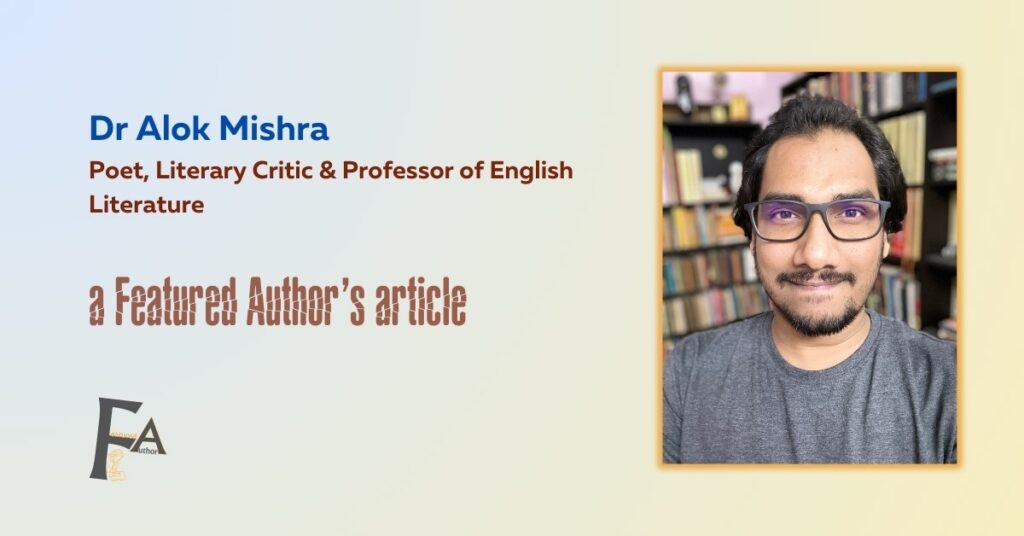
Dr Alok Mishra is a rare contemporary figure who inhabits poetry, criticism and pedagogy with equal seriousness. A poet in English (and occasionally Hindi and Maithili), a literary critic, founder of several influential digital platforms, and now a scholar of Indianness in Indian English poetry, he represents a generation of Indian writers who refuse to separate creative practice from critical reflection. His poetry collections, such as 13 Untitled and Weird Poems (2018), Moving for Moksha (2020) and Thoughts Between Life and Death (2025), trace an arc from experimentation to spiritual introspection and philosophical inquiry.
On his official website, he describes poetry as a medium that makes people aware of what they have and need in “plenty” – hope. This attitude is visible throughout his work. Thoughts Between Life and Death speaks of the “life force” as a continuum and celebrates the unending, the unborn and the undying.
At the same time, his poetry is deeply attentive to the fragility of human emotions, the ache of solitude and the burdens of knowledge. Parallel to this poetic journey runs his critical and institutional labour: founding platforms such as Ashvamegh, English Literature Education, Indian Book Critics, The Indian Authors and BookBoys PR, and hosting the podcast English Literature: The Deep Talks with Dr Alok Mishra.
In June 2025, he successfully defended his doctoral thesis, In Search of Roots: Indianness in Indian English Poetry, at Nava Nalanda Mahavihara, formally adding “Dr” to his name but, more importantly, giving academic shape to ideas that have long animated his writing.
List of Books with Publication Year
A selective but representative list of his major books is as follows:
13 Untitled and Weird Poems – Poetry collection, 2018. His debut in English poetry; experimental, compact and self-consciously “weird,” intended to make readers re-examine their lives in a brief span of reading.
Moving for Moksha – Poetry collection, 2020. Fourteen interlinked poems form a spiritual journey that draws upon ancient Hindu wisdom and explores desire, detachment and liberation.
Thoughts Between Life and Death: A Poetry Collection 2025 – Poetry collection, 2025. A set of philosophically charged poems that move through solitude, mortality, justice, regret and inner awakening, written in a contemporary idiom.
Being in Love (Bliss or Curse) 2012– A prose work focusing on honour killings and possible remedies, showing his engagement with social questions beyond the lyric self.
In addition to these, he has contributed numerous essays, editorials, and critical pieces to platforms such as Indian Book Critics, The Indian Authors, Featured Books, and others.
Writing Style
Dr Mishra’s poetic style is marked by clarity of thought, controlled emotion and a refusal to indulge in decorative obscurity. He prefers free verse, short lines and a conversational voice, but the simplicity of surface often conceals rigorous philosophical questioning.
In 13 Untitled and Weird Poems, he experiments with brevity and structure, using abrupt word sequences, sudden shifts in mood and open-ended images to unsettle habitual reading. Critics have described the collection as an attempt to respond to changing reading habits by offering intense, concentrated poetic experiences that still demand reflection, rather than passive consumption.
With Moving for Moksha, his style becomes more overtly reflective and cohesive. A detailed review phrases the book as “a philosophical journey in verse,” in which personal grief and longing are gradually transformed into universal spiritual questions.
The sequence-like structure links individual poems so that each gains resonance from the others; symbols recur, especially images of journeys, rivers, scriptures and the sacred One.
Thoughts Between Life and Death brings a further stylistic condensation. Many poems are brief, sometimes no more than a page, yet loaded with paradox. In “Justice,” the assertion that “a mother will die. / A child will be saved” and that the jury and executioner are one creates a hard, spare ethical meditation stripped of sentimentality.
In “And Regret,” a longer lyric, a nearly playful series of questions about “who knows what I know” culminates in the admission that regret itself lies in knowing, a thought that has been popularised in a Goodreads quote.
Goodreads
Throughout, his language remains accessible. Technical philosophical terms are rare; instead, he uses familiar images – trees, clouds, beds, light, cages – and bends them toward abstraction. The syntax is usually straightforward, allowing subtle shifts in tone to register clearly: irony, quiet desperation, flashes of humour, and sudden serenity often occur within the same poem. This stylistic restraint lets his philosophical and emotional concerns surface without rhetorical clutter.
Philosophy
At the heart of Dr Mishra’s work lies a sustained engagement with questions of selfhood, mortality and liberation. His poems, editorials, and interviews consistently point to a worldview shaped by Hindu philosophical thought, yet interpreted through modern existential anxieties and everyday experiences.
In the preface to Thoughts Between Life and Death, he observes that life, once germinated, must end, but “the life force does not end. It is a continuum,” clearly echoing the Bhagavad Gita’s teachings while emphasising that the poems “celebrate the life force, the unending, and that which never begins.”
Moving for Moksha carries this further by turning the poetic sequence into a spiritual pilgrimage. Reviews note how the collection uses the protagonist’s personal suffering to explore the human quest to be “one with the One,” drawing upon Hindu scriptures, mythic allusions and the vocabulary of moksha and rebirth.
His philosophical reflections are not confined to poetry. In his editorial “Poetry and Science: The connection we seldom discuss,” he argues against the assumption that poets are socially useless. Instead, he insists that poets “annunciate vision” and provide the imaginative horizon within which scientific discovery becomes possible, seeing poetry and science as complementary rather than opposed enterprises.
Similarly, in a widely circulated piece on solitude, he distinguishes loneliness as a passive condition from solitude as a conscious, empowering choice, a state that allows the poet to observe, assess and distil experience with detachment. These reflections mirror his own poetic practice, where solitude is not self-pity but a vantage point from which the transient drama of life can be seen clearly.
His recent PhD on Indianness in Indian English poetry further clarifies his philosophical concerns. Articles describing his research note that he treats Indianness not as a fixed essence but as a “dialectical movement between the past and the present, tradition and modernity, the local and the global,” explored through poets ranging from Nissim Ezekiel and Kamala Das to Jayanta Mahapatra and A. K. Ramanujan. This dynamic, fluid understanding of identity also informs his own poems, which constantly negotiate between rootedness and cosmopolitan awareness.
As a Literary Critic
Dr Mishra is not simply a poet who occasionally comments on books; he is one of the more visible Indian literary critics working in the digital space today. His reviews and essays appear primarily on Indian Book Critics, where he is a leading voice, as well as on other platforms such as Featured Books, The Indian Authors, Intellectual Reader, and more.
Three features mark his criticism:
Clarity and accessibility. Even when dealing with canonical texts – Mark Twain, Albert Camus, Yukio Mishima – his articles are written for general readers, combining context, thematic analysis and evaluative judgement in an unpretentious style.
A concern with Indianness. Editorials and opinion pieces repeatedly return to the question of how Indian literature, in English and in translation, should be read from an Indian-centred perspective. In an article on the image of India in world literature, he explicitly advocates “an Indian interpretation of Indian and world literature,” arguing that platforms like English Literature Education exist to give students free, contextualised resources rather than imported critical templates.
A philosophy of criticism as service. An academic feature summarising his ideas on criticism notes his view that literary criticism “directly serves the collective consciousness of humanity,” by clarifying values, sharpening perception and connecting readers with deeper meanings in texts.
His editorials “What Makes a Good Reader,” “What Makes a Literary Classic,” “Creativity Beyond Classrooms”, and “What is Poetry for me, after all these years?” further demonstrate a self-reflexive critical practice. In them, he examines reading habits, the formation of taste, the dangers of mechanically taught literature and the changing status of poetry in a world dominated by technology and artificial intelligence.
As a critic, he also builds institutions. He founded Ashvamegh as an international journal and publication space, English Literature Education as a free resource platform, English Literature Forum as a discussion community, and BookBoys PR as a dedicated publicity agency for authors and publishers. These initiatives extend his critical work beyond individual essays into the creation of ecosystems where literature is discussed, promoted and studied.
Inspiration & Sources
Dr Mishra’s sources of inspiration can be grouped into three broad categories:
Indian spiritual and literary traditions.
Moving for Moksha openly draws on Hindu mythology and philosophy; reviews highlight that many lines and assertions are “directly extracted from Hindu scriptures,” and the collection invites readers to undertake a journey towards union with the divine. His critical essays on Sri Aurobindo, Sarojini Naidu and Toru Dutt show his deep engagement with Indian poetic spiritualities and how they fuse rhythm, philosophy and national imagination.
Global literary and philosophical currents.
His reviews and podcast episodes reference writers such as Camus, Mark Twain, Yukio Mishima, and Jules Verne, suggesting a reading life that ranges widely across cultures and periods. He often draws on Western theorists and classics to sharpen his reflections on Indian texts, always with an eye on local realities.
Solitude, observation and everyday life.
The solitude editorial describes how poetic insight arises when one deliberately steps back from emotional entanglements in order to see clearly. Poems such as “Watching Sunset, Under the Tree” and “Wide Blue Horizon” in Thoughts Between Life and Death transform ordinary experiences – sitting under a tree, waking from a disturbing dream – into occasions for metaphysical reflection.
Taken together, these influences make his writing at once recognisably Indian and globally conversant. The Upanishadic and Gita-inflected vocabulary of soul, detachment and eternal flow coexists with discussions of artificial intelligence, scientific progress and contemporary reading practices.
Situating Dr Alok Mishra on the Canvas of Indian English Poetry
Within the broader field of Indian English poetry, Dr Mishra belongs to a growing group of poets who combine spiritual inquiry with a consciously postcolonial self-awareness. His work is not overtly political in the narrow sense, yet it is deeply engaged with questions of identity, language and cultural memory.
His doctoral research has already begun to influence how he is perceived critically. Articles on his thesis describe him as “an authority on the subject of Indianness in Indian English poetry,” whose readings of Ezekiel, Kamala Das, Mahapatra, Ramanujan and others refuse to treat Indianness as a monolithic attribute. Instead, he sees it as a conversation between modernity and tradition, between city and village, between coloniser and colonised, between inner spiritual life and outer socio-political realities.
This methodological stance informs his own English-language poems. While his diction is contemporary and unforced, his thematic preoccupations – moksha, karma, rebirth, the cosmic flow – are unmistakably drawn from Indian metaphysical discourse. Reviews of Moving for Moksha and Thoughts Between Life and Death repeatedly describe them as rooted in Indian philosophy yet accessible to modern readers.
Unlike earlier generations who often wrestled with the legitimacy of writing in English, Dr Mishra takes the language as a given and pours Indian idioms, experiences and philosophical structures into it. His editorial “Let us have an Indian interpretation of Indian and world literature” directly argues that Indians should read and interpret literature from their own vantage point rather than uncritically rely on Western critical frameworks.
This insistence on intellectual self-reliance aligns his position with broader postcolonial movements, yet his tone remains measured and dialogic rather than polemical.
On the canvas of Indian English poetry, he therefore occupies a dual role: practitioner and theorist. His own verse enacts the possibilities of spiritual-philosophical poetry in English, while his criticism and PhD research offer tools for understanding what “Indianness” might mean in that context.
Legacy & Future Expectations
Even at this stage, Dr Mishra’s legacy is already visible in several overlapping spheres.
Poetic corpus.
With three English poetry collections and additional work in Hindi, he has produced a body of verse that charts a clear trajectory from experimental compression to spiritual sequences and metaphysical vignettes. Critical responses on various platforms treat Moving for Moksha and Thoughts Between Life and Death as essential contributions to contemporary Indian English poetry, especially for readers drawn to philosophical and spiritual themes.
Critical and editorial influence.
Through Indian Book Critics, The Indian Authors, Ashvamegh, and other portals, his editorials and reviews shape reading choices for thousands of readers. At the same time, his essays on classics, modern novels and non-fiction titles maintain a rare balance between accessibility and depth.
Institution-building.
Perhaps his most distinctive contribution lies in creating spaces where literature is not confined to elite classrooms. Ashvamegh Journal, English Literature Education, English Literature Forum and BookBoys PR together form a web of initiatives that support writers, students and scholars, often offering free resources and opportunities for dialogue.
Pedagogical reach.
His podcast English Literature: The Deep Talks with Dr Alok Mishra, and his online lectures on topics such as irony, allegory, reading classics, and writing critical appreciation, have introduced structured literary discussion to a broader, often non-metropolitan, audience.
Looking ahead, his recently completed PhD suggests several future directions. He is well placed to write an influential monograph on Indianness in Indian English poetry, expanding his doctoral work for a broader readership. Given his interest in integrating criticism with public discourse, one can also anticipate more editorials that translate complex postcolonial debates into accessible essays for students and general readers.
On the creative side, the progression from 13 Untitled and Weird Poems to Thoughts Between Life and Death hints at further experiments in long-form poetic sequences, perhaps engaging more directly with historical and cultural memory while retaining his meditative core. His reflections on the future of poetry in the age of artificial intelligence and his insistence that literature “cannot be dictated” from classrooms but must grow from genuine engagement indicate that he will continue to respond actively to technological and cultural shifts.
Conclusion
Dr Alok Mishra’s profile, viewed in its totality, presents a writer who refuses easy compartmentalisation. He is at once a poet of solitude and spiritual quest, a critic concerned with Indianness and global dialogue, a teacher who insists that students read original texts, and an institution-builder who has harnessed digital platforms for literary ends.
His poetry invites readers to sit with uncomfortable questions: the meaning of justice when stripped of sentimentalism, the burden and regret of knowing, the thin line between loneliness and chosen solitude, the quiet companionship of trees and sunsets, and the possibility of moksha amid contemporary restlessness.
His criticism, meanwhile, positions literature as an ongoing conversation that shapes a nation’s self-image, directs cultural memory, and, in his own words, serves the collective consciousness of humanity. His PhD on Indianness in Indian English poetry gives this vision a rigorous scholarly foundation, ensuring that future debates on Indian identity in literature will have to reckon with his arguments.
Taken together, his achievements illustrate a model of literary life that is rooted, reflective and outward-looking. He stands on the contemporary canvas of Indian English poetry as both participant and interpreter, and his evolving work promises to deepen, rather than extend, the traditions he inherits.
By Ashish M for Featured Author
Thanks for reading this article!
..