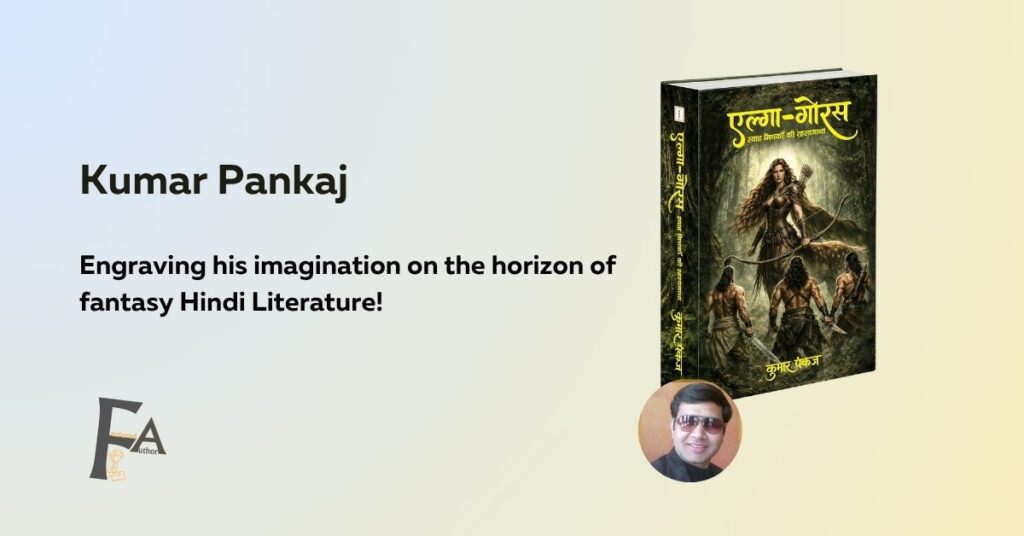
The first time I encountered Kumar Pankaj was not through an interview, a literary discussion, or a recommendation from a critic. It was through the world of Elga Gorus. Like many readers of my generation, I had reached a point where a great deal of contemporary fiction felt increasingly predictable. The stories were often competent, sometimes beautifully written, but they seemed to operate within familiar boundaries. Then came Elga Gorus, and within a few chapters, I found myself asking a very different question. Who is the person capable of imagining all this?
The question stayed with me long after I finished both volumes. Not because the books were merely entertaining, but because they revealed a creative ambition that is relatively rare in contemporary Hindi literature. There was a scale to the imagination that immediately stood out. Strange civilisations, mysterious creatures, ancient scripts, forgotten histories, hidden knowledge systems, symbolic journeys, and an entire mythology unfolding across hundreds of pages suggested something larger than a novel. They suggested a literary vision. The more I thought about it, the more I realised that Elga Gorus was not simply the product of a writer trying to tell a story. It appeared to be the work of a writer trying to solve a problem.
That problem, as I understand it, is the question of readership.
For decades, Hindi literature has possessed extraordinary strengths. It has produced remarkable poetry, powerful social novels, insightful memoirs, historical narratives, political commentary, philosophical writing, and literary fiction of great depth. Yet there has always been a significant category of readers who remained underserved. These are readers who love imagination, mystery, adventure, mythology, fantasy, speculative storytelling, and immersive world-building. Many of them eventually migrated toward English-language fiction because they simply could not find enough material within Hindi literature that addressed their interests. This is not a criticism of Hindi literature itself. It is merely an observation about literary supply and reader demand.
Kumar Pankaj appears to have recognised this gap earlier than many others.
The significance of Elga Gorus lies not merely in what it is, but in whom it is trying to reach. Several reviewers have noted that the novel revives the spirit of fantasy, mystery, and tilism in a literary environment where such storytelling has become relatively uncommon. Critics have described it as an ambitious attempt to create a new imaginative universe within contemporary Hindi literature rather than simply another novel within an existing tradition.
This is where Kumar Pankaj’s vision becomes particularly interesting. He is not writing fantasy merely because he enjoys fantasy. He appears to be writing fantasy because he believes a generation of Hindi readers deserves fantasy of its own.
The easiest way to understand his project is to look at the reading habits of young Indian readers over the last two decades. A teenager interested in fantasy was likely to discover global franchises, large-scale mythological worlds, magical schools, dark fantasy sagas, speculative universes, and expansive fictional ecosystems through English-language publishing. Those books became cultural events. They generated communities, discussions, fan theories, adaptations, and lifelong readers. Meanwhile, Hindi literature often remained associated with a different set of expectations. Readers came to it for realism, social commentary, literary seriousness, or historical narratives. Kumar Pankaj seems determined to challenge that perception.
What makes his effort particularly noteworthy is that he does not attempt to imitate Western fantasy models. Many writers facing a similar challenge might simply transplant familiar fantasy structures into Hindi. That would have been the easier route. Instead, Elga Gorus operates through a distinctly Indian imaginative sensibility. Its mysteries emerge from hidden knowledge, forgotten traditions, ancient texts, symbolic journeys, secret histories, and mythic ambiguity. Several reviews have highlighted this very quality, arguing that the novel offers fantasy without forcing Indian readers to abandon their own cultural instincts. The mythology feels original while remaining emotionally and culturally familiar.
This choice reveals a great deal about Kumar Pankaj as an author. He appears less interested in importing fantasy than in indigenising it. The distinction matters because literature grows strongest when it speaks in its own voice. Readers do not need another imitation of international trends. They need stories that emerge from their own imaginative landscape. The world of Elga Gorus feels rooted in exactly that aspiration. Its creatures, mysteries, symbols, and mythologies do not seem designed primarily for global validation. They seem designed for reader immersion. Kumar Pankaj writes as though he trusts the imaginative appetite of Hindi readers, and that trust may be his greatest strength.
His writing style reinforces this objective. One repeatedly notices his preference for visual storytelling. Readers and critics alike have pointed to the cinematic quality of the novels, their rich imagery, and their ability to create memorable mental landscapes. This visual instinct is not merely an artistic choice. It serves a strategic purpose. Contemporary readers have grown up surrounded by visual media. Films, streaming platforms, graphic storytelling, gaming environments, and digital content have transformed expectations. Kumar Pankaj appears to understand that if literature wishes to compete for attention, it must create experiences that feel immersive. His prose often functions less like description and more like visual architecture. Readers do not simply read about a place. They enter it.
Another revealing aspect of his vision is his willingness to embrace scale. Most contemporary writers seek economy. They simplify. They compress. They reduce. Kumar Pankaj does the opposite. He expands. The universe of Elga Gorus contains numerous characters, elaborate mythologies, hidden histories, symbolic systems, and interconnected mysteries. Several reviews have noted the extraordinary ambition of the world-building involved.
This expansion reflects a broader creative philosophy. Kumar Pankaj seems convinced that readers are willing to invest themselves in large literary experiences if those experiences reward their curiosity. In an age often described as hostile to long-form reading, that is a surprisingly optimistic belief. More importantly, the enthusiastic reader response suggests that he may be correct.
The available Goodreads data offers an interesting glimpse into this response. Among Kumar Pankaj’s published works, the Elga Gorus volumes have emerged as his most visible and highly rated titles, maintaining strong reader engagement and ratings. While ratings are not a substitute for literary evaluation, research on Goodreads behaviour indicates that reader engagement often provides meaningful insight into a book’s cultural reach and influence.
The enthusiasm surrounding Elga Gorus suggests that Kumar Pankaj may have identified a readership that was waiting for exactly this kind of work.
Of course, no serious assessment should ignore the challenges. The same qualities that make Kumar Pankaj distinctive also create potential limitations. His narratives demand attention. His worlds are dense. His casts are large. His mythologies require patience. Readers seeking immediate simplicity may occasionally find themselves overwhelmed. Critics have noted that the scale of Elga Gorus can sometimes feel demanding because of the numerous characters, locations, and narrative threads involved. Yet these challenges arise from an excess of ambition rather than an absence of talent. Indeed, one might argue that the most encouraging thing about Kumar Pankaj’s future is that many of his limitations are the kind that tend to improve with experience. Narrative economy can be refined. Structural discipline can become sharper. Character management can become more efficient. What cannot be taught as easily is vision. That either exists or it does not. In Kumar Pankaj’s case, it clearly exists. What remains to be seen is how far he chooses to take it.
If Elga Gorus is viewed not merely as a successful fantasy novel but as the opening chapter of a larger literary project, then Kumar Pankaj’s future becomes particularly intriguing. He has already demonstrated that Hindi readers are willing to embrace ambitious fantasy. He has shown that mystery, mythology, and large-scale world-building can attract attention within a literary culture often assumed to prefer realism. Most importantly, he has shown younger readers that Hindi literature can be imaginative without apology.
That may ultimately become his most enduring contribution.
Long after debates about individual novels fade, literature remembers the writers who expanded its possibilities. Kumar Pankaj’s significance lies not simply in the worlds he has created, but in the readers he is trying to create. He appears to be writing for those who might otherwise have abandoned Hindi fiction altogether in search of imaginative experiences elsewhere. By offering them mystery, wonder, adventure, and immersive storytelling within their own language, he is attempting something larger than genre fiction. He is attempting audience-building. And if the response to Elga Gorus is any indication, that effort has already begun to bear fruit.
Gaurav for Featured Author
Thanks for reading!
. . .